
Is Goldenrod a Weed? The Truth About This Misunderstood Plant
Goldenrod (Solidago spp.) is one of the most misidentified plants in North America and Europe — dismissed as a roadside weed when, in reality, it is a vital native wildflower with enormous ecological, ornamental, and even medicinal value.
The short answer: goldenrod is not a weed, though it can behave like one if left unmanaged in the wrong setting.
What Is Goldenrod?
Goldenrod plants with dense yellow flower clusters in a field
Goldenrod is a herbaceous perennial plant belonging to the genus Solidago, part of the Asteraceae family. BONAP (Botanical Atlas of North American Plants) recognizes up to 100 species of goldenrod in North America, all of which are native to the continent. Every fall, goldenrod produces hundreds of tiny 1/8 to 1/4-inch individual yellow flowers that bloom together in wand-like arching clusters, creating those stunning golden displays seen across meadows, roadsides, and prairies. Its Latin name, Solidago, literally means "to make whole" — a nod to its long history in herbal medicine.
Why Do People Think Goldenrod Is a Weed?
The "weed" reputation comes from a few legitimate reasons:
-
Aggressive spreading: Some species, especially Solidago canadensis (Canada goldenrod), spread both by tiny airborne seeds and by underground rhizomes, forming large dense colonies that can crowd out other plants.
-
Ubiquitous roadside presence: It thrives in disturbed soils, roadsides, and untended areas, giving it the visual profile of a "weedy" plant.
-
Invasiveness outside its native range: In Europe, Solidago gigantea (late goldenrod) is classified as one of the most invasive alien species, forming dense monospecific stands that reduce plant biodiversity and alter soil chemistry.
-
Mistaken identity with ragweed: Goldenrod blooms at the same time as ragweed each fall, leading millions of people to blame it for seasonal allergies.
The key distinction is context: in its native North American habitat, goldenrod is a keystone species; introduced to ecosystems abroad without its natural predators, it can become genuinely problematic.
Does Goldenrod Cause Allergies? (The Big Myth)
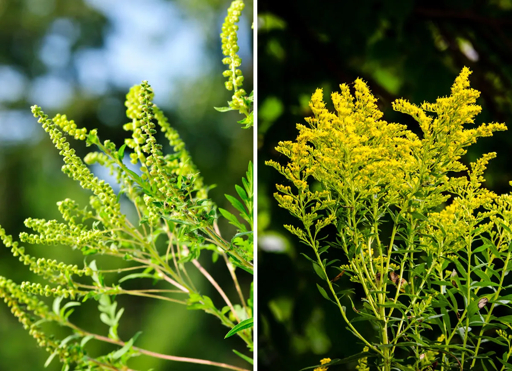
Goldenrod yellow flowers compared to ragweed green flowers
No. Goldenrod does not cause hay fever. This is arguably the most persistent myth about the plant. Goldenrod pollen is heavy and sticky, meaning it must be carried by insects — it cannot travel through the air to irritate your nose. The real culprit is ragweed (Ambrosia spp.), which blooms at exactly the same time and produces light, wind-carried pollen that triggers allergic rhinitis. Ragweed has inconspicuous green flowers that nobody notices, while goldenrod's bold yellow blooms steal all the attention — and the blame.
Goldenrod as a Pollinator Powerhouse
Far from being an ecological villain, goldenrod is one of the most important plants for biodiversity in late summer and fall.
-
Supports 35+ specialist bee species whose larvae can only survive on goldenrod pollen — without goldenrod, those bees would go extinct.
-
Feeds monarch butterflies during their fall migration, providing critical fuel when most other flowers have stopped blooming.
-
Hosts 100+ moth and butterfly species in their larval stage.
-
Attracts wasps, beetles, and beneficial flies that act as natural pest controllers in the garden.
-
Provides winter food for birds through its seeds during the coldest months.
Goldenrod and asters (Symphyotrichum spp.) are recognized as the two most important late-season sources of pollen and nectar for bees that are preparing their nests for winter.
Garden Value: Ornamental Uses
Far from being relegated to the wild, goldenrod is increasingly prized in ornamental gardens. Several species and hybrids perform exceptionally well in home landscapes. Here are some top varieties recommended for gardeners:
| Variety | Height | Key Feature |
|---|---|---|
| Solidago rugosa 'Fireworks' | 3 ft | Dramatic arching sprays; top-rated at Chicago Botanic Garden |
| Solidago 'Goldkind' | 1.5–2 ft | Compact, clump-forming, non-aggressive, great for cutting |
| Solidago 'Little Lemon' | 1 ft | Dwarf variety, ideal for containers and borders |
| Solidago 'Baby Sun' | 2 ft | Early bloomer, stays upright, disease-resistant |
| Solidago caesia (Bluestem) | 1–4 ft | Tolerates partial shade, woodland gardens |
Goldenrods are extremely hardy, drought-tolerant, and require minimal maintenance once established. They combine beautifully with purple asters, sedums, and native grasses for spectacular fall color combinations.
Medicinal and Historical Uses
Goldenrod has a rich history in traditional medicine that spans Native American, European, and Appalachian herbal traditions. Its aerial parts — flowers and leaves — have been used for centuries for their:
-
Anti-inflammatory and diuretic properties: Used for urinary tract health, kidney stone prevention, and bladder irritation.
-
Respiratory relief: A traditional remedy for seasonal allergies, sinus infections, rhinitis, colds, and flu.
-
Wound healing: Applied topically as a poultice for wounds, burns, sores, and even toothaches.
-
Digestive support: The bitter flavor stimulates digestion and has been used to reduce intestinal inflammation.
Historically, figures like Henry Ford, George Washington Carver, and Thomas Edison even explored goldenrod as a source of natural rubber from its leaves.
⚠️ Note: While goldenrod has a strong ethnomedicinal tradition, most clinical evidence in humans is still limited. Always consult a healthcare professional before using it medicinally.
How to Manage Goldenrod in Your Garden
If you're dealing with aggressive spreading from wild-type species like Solidago canadensis, management is straightforward:
-
Choose compact, non-invasive cultivars like 'Goldkind' or 'Little Lemon' for small gardens.
-
Mow twice per year (mid-June and again in fall) to significantly reduce rhizome density — studies show a 61% reduction in shoot density with two annual mowings.
-
Deadhead before seeds form to prevent wind dispersal and unwanted reseeding.
-
Plant in containers if you want the benefits but fear spread in tight spaces.
-
Use as a naturalizing plant in larger wild areas, meadow gardens, or prairie restorations where its spreading habit is an asset, not a problem.
The Verdict: Weed or Wildflower?
A plant is only a "weed" when it's growing where it's not wanted. In its native North American range, goldenrod is a keystone species, a pollinator superstar, a medicinal herb, and an increasingly celebrated ornamental garden plant. Its aggressive reputation stems mainly from wild-type species in non-native contexts or neglected landscapes. Choosing the right variety and placing it correctly transforms goldenrod from a nuisance into one of fall's most rewarding plants — for both your garden and the local ecosystem.