Japanese Beetles: The Complete Guide to Identification, Damage & Control
Japanese beetles (Popillia japonica) are one of the most destructive invasive pest insects in North America, capable of devastating gardens, lawns, and crops in a matter of weeks.
If you've ever found your rose bushes stripped bare or your lawn turning into a patchwork of dead, spongy turf, this beetle is likely the culprit.
What Is the Japanese Beetle?
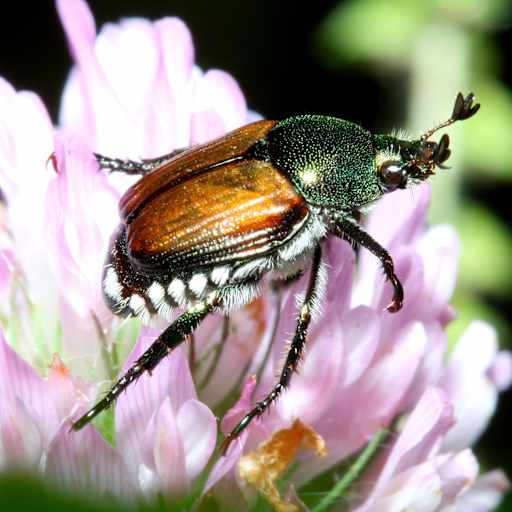
Iridescent green and copper Japanese beetle on pink flower
The Japanese beetle is a scarab beetle native to northern Japan, first discovered in the United States in 1916 in a shipment of iris bulbs in New Jersey. Without its natural predators from Japan, it spread rapidly across the continent and is now established in most states east of the Mississippi River, with ongoing incursions into western states and parts of Europe. USDA's Animal and Plant Health Inspection Service (APHIS) classifies it as a major destructive pest of turf, grass, and over 300 ornamental and agricultural plants.
How to Identify Japanese Beetles
Japanese beetles are visually striking and relatively easy to recognize once you know what to look for:
-
Size: About ½ inch (12–13 mm) long
-
Head and thorax: Metallic bright green, highly iridescent
-
Wing covers (elytra): Coppery brown or bronze
-
Distinctive markings: 5 white tufts of hair along each side of the abdomen, plus 2 more at the tip — a key identification feature
-
Grubs: C-shaped, creamy white, about 1 inch long when fully grown, found 2–4 inches below soil surface
Adults are most active on warm, sunny days between 9 AM and 3 PM, and are rarely seen feeding during rain or on cool, cloudy days.
Life Cycle: Understanding the Enemy
Japanese beetles undergo complete metamorphosis in a one-year cycle, spending roughly 10 months underground as grubs and only 2 months as visible adults.
| Stage | Timing | What Happens |
|---|---|---|
| Egg | Late June–August | Females burrow 2–3 inches into soil, laying 1–5 eggs at a time, up to 40–60 total |
| Larva (Grub) | July–May | Grubs hatch in ~2 weeks and feed on grass roots through fall; burrow deep in winter |
| Pupa | Late spring | Grubs pupate 2–4 inches underground for ~2 weeks |
| Adult | Late June–August | Adults emerge, feed for 30–45 days, mate, and repeat the egg-laying cycle |
In colder, northern climates or high-altitude zones, the cycle can extend to two years. Climate change projections indicate rising temperatures will expand their range northward into Canada and across northern Europe by midcentury.
What Plants Do Japanese Beetles Damage?
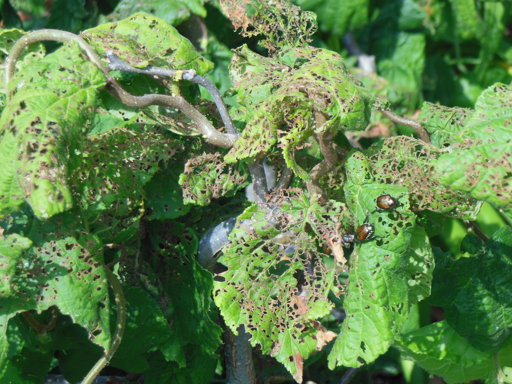
Adults are voracious, non-discriminatory feeders with a preference list of over 350 plant species. They feed on the upper leaf surface, consuming the soft tissue between veins and leaving behind a characteristic lace-like skeleton.
Their Favorite Targets
-
Ornamentals: Roses, linden, Japanese and Norway maple, birch, crabapple, mountain ash
-
Fruits: Grapes, peaches, plums, cherries, apples
-
Vegetables & herbs: Basil, beans, corn
-
Turf: Grubs target roots of Kentucky bluegrass, fine fescues, ryegrasses, and bentgrasses
Plants Japanese Beetles Tend to Avoid
Some plants act as natural deterrents and can be strategically planted near vulnerable specimens:
-
Catnip, garlic, leeks, chives, and onions
-
Marigolds and nasturtiums
-
Boxwood, holly, juniper, and dogwood
The Double Threat: Adults AND Grubs
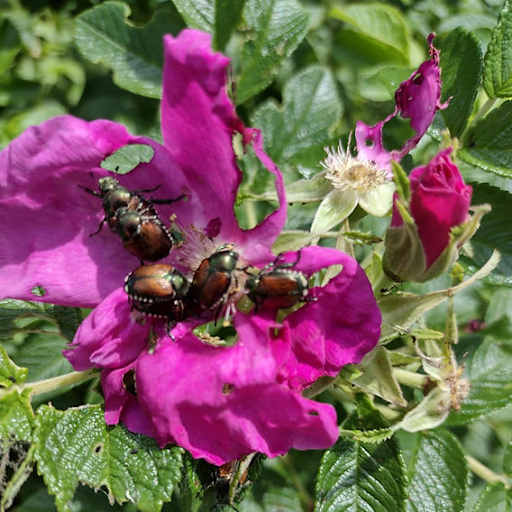
Japanese beetles on pink rose flower
What makes Japanese beetles uniquely destructive is that they cause damage at two different life stages simultaneously:
Adult feeding (aboveground): Skeletonizes leaves from the top of the plant downward. Adults use pheromones to recruit other beetles, meaning damage accelerates rapidly once the first few arrive — a classic mob feeding behavior. Roses and other ornamentals can be reduced to bare stems within days.
Grub feeding (belowground): White grubs chew through grass roots, severing the plant's ability to absorb water and nutrients. Affected lawn areas turn pale yellow-brown — often mistaken for drought stress — and in severe cases the dead turf can be rolled back like a carpet. Secondary damage occurs when skunks, raccoons, and crows dig up lawns to feed on the grubs.
Are Japanese Beetles Harmful to Humans or Pets?
Japanese beetles are not dangerous to people or pets. They do not bite, sting, or transmit disease. The harm they cause is entirely agricultural and horticultural. However, because they attack food crops and ornamental plants so aggressively, the economic damage is enormous — costing the U.S. an estimated $460 million annually in damage and control costs.
How to Get Rid of Japanese Beetles
Manual & Immediate Methods
-
Hand-picking into soapy water: The single most effective method for small infestations. Fill a bucket with a few inches of water and a few drops of dish soap, hold under the plant, and knock the beetles in. Do this early morning when they are sluggish and less likely to fly.
-
Soap spray: Mix 1–2 tablespoons of dish soap in a spray bottle with water and spray directly onto beetles and affected foliage.
-
Neem oil spray: A natural, OMRI-listed botanical insecticide. It acts as an antifeedant and disrupts the beetle's hormonal development. Reapply after rain.
-
Diatomaceous earth: Food-grade diatomaceous earth dusted on leaves damages the beetles' exoskeleton through abrasion.
Soil-Level Grub Control
-
Milky Spore (Bacillus popilliae): A naturally occurring bacterium that infects and kills Japanese beetle grubs in the soil. When grubs ingest the spores and die, they release billions of new spores, creating a self-perpetuating soil treatment that can last up to 3–4 years. Best for long-term prevention.
-
Beneficial nematodes (Heterorhabditis bacteriophora): Microscopic roundworms that actively hunt and parasitize grubs in the soil. More immediate than milky spore but shorter-lasting, needing reapplication every 4–6 weeks during peak grub season. Soil must be moist and loose for best results.
What About Japanese Beetle Traps?
This is one of the most debated topics in Japanese beetle control — and the science is clear: beetle traps are generally counterproductive for home gardens. While commercial traps use powerful pheromone and floral lures that attract beetles by the hundreds, research shows they only capture 50–75% of the beetles they attract. The rest land near the trap and feed on your plants. Studies confirm that damage actually increases in gardens near traps because they draw in beetles from surrounding areas. The University of Minnesota Extension explicitly advises homeowners not to use Japanese beetle traps.
✅ Exception: Traps may be useful in isolated areas with low beetle populations, or as part of a coordinated neighborhood-wide trapping program.
Prevention: Stop Next Year's Infestation Now
The best time to break the beetle cycle is late summer and early fall, when grubs are newly hatched and close to the soil surface:
-
Apply nematodes or milky spore in August–September when grubs are young and feeding near the surface.
-
Water your lawn deeply but infrequently — female beetles prefer moist, well-irrigated turf for egg-laying. Allowing lawns to go dry in July can deter egg-laying and kill newly hatched eggs.
-
Avoid over-fertilizing with nitrogen, which produces the lush, soft growth beetles find most attractive.
-
Plant beetle-resistant species as a buffer around vulnerable plants — marigolds, catnip, garlic, and chives have natural repellent properties.
-
Remove damaged fruit and fallen plant material promptly, as fermenting plant matter attracts beetles.
Japanese Beetles in Europe: A Growing Threat
While Japanese beetles have been established in the eastern U.S. for over a century, their spread into Europe is more recent and alarming. They were first detected in northern Italy in 2014 and have since spread to Switzerland, France, and parts of the Azores. A 2025 study published in Nature modeled their continued spread into the near future, identifying Spain, France, Romania, Ireland, and the UK as especially at risk due to favorable climates and large pastoral areas.
Climate models project their suitable European range will increase by 23% by midcentury, particularly across the UK, Ireland, and Scandinavia. For gardeners and farmers in Europe, this makes early identification and reporting to agricultural authorities more important than ever.
Quick Reference: Japanese Beetle Control at a Glance
| Method | Target Stage | Effectiveness | Notes |
|---|---|---|---|
| Hand-picking + soapy water | Adult | ✅ High | Best done early morning |
| Neem oil spray | Adult | ✅ Good | Reapply after rain |
| Milky spore | Grub | ✅ Long-term | Builds up over 2–3 seasons |
| Beneficial nematodes | Grub | ✅ Fast | Needs moist soil, reapply seasonally |
| Pheromone traps | Adult | ❌ Usually counterproductive | Attracts more beetles than it catches |
| Diatomaceous earth | Adult | ⚠️ Moderate | Avoid near pollinators |
| Lawn drought stress | Egg/Young grub | ✅ Preventive | Reduces egg-laying success |
The key to managing Japanese beetles is combining immediate manual control with soil-level biological treatments for long-term reduction, while steering clear of the trap myth. Consistency across two to three seasons using milky spore and nematodes is the closest thing to a lasting solution currently available to home gardeners.
Tobaccos Cost within TX: It Smells